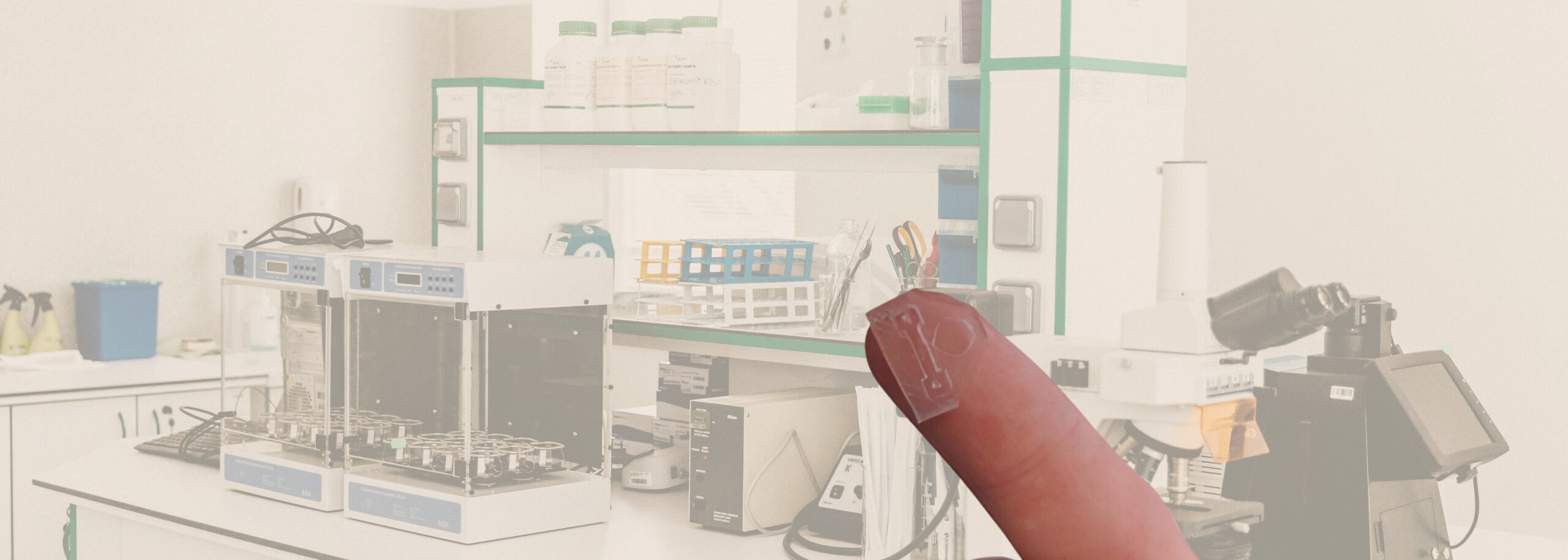

Every year, thousands of women in the Netherlands are told they have breast cancer. For many of them, the disease becomes chronic. Treatments are heavy and invasive. Researchers Séverine Le Gac and Julieta Paez and their team are working on a new way of conducting research on breast cancer. They are developing a “smart chip” to better understand how breast cancer behaves in the human body—without using laboratory animals.
A tumor-on-a-chip
Séverine explains how they do this: “We build a very small model of a human breast tumor. We do this in a chip with tiny channels and chambers. In that chip, we place different types of human cells and other materials. In this way, we can mimic the breast tumor and the environment in which it grows as accurately as possible. Aspects we are focusing on are: how stiff the tissue is, how much oxygen is available, how acidic the environment is—and so on.”
Julieta adds: “So we don’t take a piece of tumor from a patient to grow it in a chip. Instead, we choose very precisely which ‘ingredients’ we need to conduct our research. We only use the components that are important for better understanding how a tumor grows and how we can treat it.”
What makes this chip so smart
The chip is called SMART-ToC: this stands for Smart Tumor-on-Chip. “Tumors are actually very smart,” says Séverine. “They change constantly. So if you really want to understand the disease, you need a smart model that can show how things change over time and in different parts of the tumor.”
One example is tissue stiffness. Healthy breast tissue feels soft, but a tumor often feels like a hard lump. “The harder the tissue, the more difficult it is for medications to penetrate,” Julieta explains. “On our chip, we can mimic and measure that. We build in sensors that monitor things like stiffness, oxygen levels, and acidity while the tumor is developing.”
They can also test how new drugs behave in an environment that resembles the patient’s body as closely as possible, because the research model is made from human cells and adjusted to closely copy the conditions inside a tumor.”
Many medicines are still tested on animals. But animals are not copies of humans. As a result, findings from animal studies often cannot be translated to humans. “Laboratory animals suffer, while the results are often not useful for people,” says Séverine. With the smart chip, researchers can see at an early stage which treatments are likely to be effective in humans.
Without laboratory animals—and without animal-derived material
The team goes one step further than simply avoiding animal testing. “A lot of research still uses materials that come from animals, such as collagen from rats or pigs,” says Julieta. “We prefer to use animal-free alternatives.”
This is not only better for animal welfare, but also beneficial for science. Animal-derived materials can vary from batch to batch, while collagen produced in a controlled way is consistent. “That means you can repeat studies more reliably and check whether you get the same results each time,” Julieta explains. The downside is that these new materials are still difficult to obtain and expensive. “That’s exactly why it’s important for us to show that it works. Then it becomes more attractive for companies to invest, and costs will eventually go down.”
Working with patients and society
Another special aspect of the SMART-ToC project is its focus on social and ethical questions and aspects. From the very beginning, the team has been collaborating with patient organizations, other researchers, companies, and experts in ethics and society.
“Imagine a doctor telling a patient in the future, ‘This medicine has been tested on a chip, not on animals.’ How will someone respond?” Séverine explains. “We want to ask those kinds of questions now already, so we can be sure that our research model will truly be accepted and therefore used.” By having these conversations from day one, the team can already adjust the model during development. This ensures an approach that is not only scientifically sound but also aligned with what patients, doctors, and society find important.
Investing in an animal-free future
A large, interdisciplinary team of researchers with different backgrounds is working on the SMART-ToC project. They need specialized equipment, expensive materials, and a great deal of time to build, test, and improve the model.
With additional financial support, the team can demonstrate more quickly that their model works and that it can genuinely replace animal testing. That is good news for women with breast cancer, for future patients, for their family and relatives, and for animals. By investing in this research, you help contribute to a future in which breast cancer research becomes more human-centered, more animal-friendly, and ultimately more effective.
Discover more