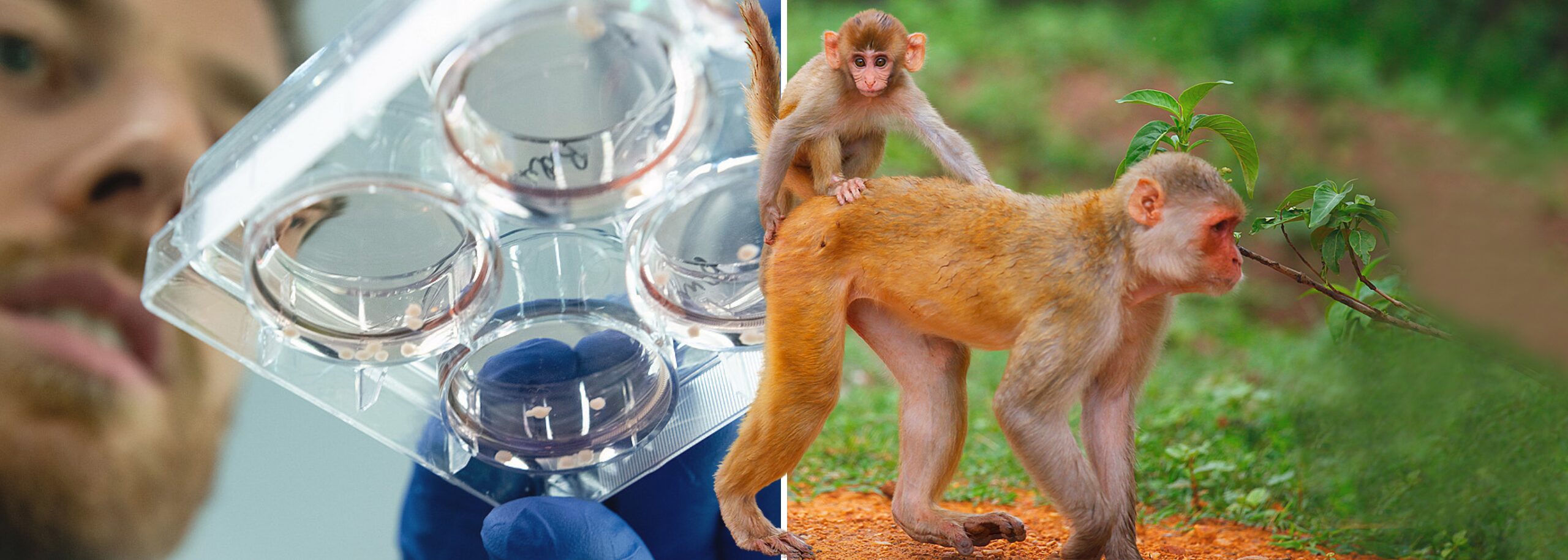

What if we could use a virtual embryo to predict which substances are harmful to an unborn child—without the need for animal testing? Job Berkhout from Vrije Universiteit Amsterdam is working on precisely such an innovative research method. And with great success: on November 13, he won both the jury prize and the audience award for the 2026 Hugo van Poelgeest Prize! The awards were presented during “The Future is Human(e)” in Leiden—an event we organized in collaboration with the foundation Stichting Bouwstenen voor Dierenwelzijn (Building Blocks for Animal Welfare).
A virtual embryo instead of laboratory animals
Using artificial intelligence and computer models, Job is developing a so-called “virtual embryo.” His goal is to predict which substances might be harmful to the early development of an unborn child’s nervous system.
His research demonstrates the possibilities and opportunities inherent in animal-free science. By leveraging new technologies, we are increasingly able to study how substances affect our bodies—without relying on animal testing.
This achievement did not go unnoticed. From a pool of 21 nominated young researchers, an independent scientific jury selected three finalists, ultimately choosing Job as the winner. He will receive €5,000 to further advance his animal-free research. The public was also impressed: Job additionally won the public choice award, which comes with a prize of €1,500!
Debby Weijers, director of Proefdiervrij, is enthusiastic about his work: “Job has presented his complex research in an incredibly clear and compelling way.”
From a childhood dream of becoming a veterinarian to animal-free science
It is no surprise that Job is committed to the welfare of animals; his love for them began at a young age—though his vision for the future was once a bit different.
“When I was younger, I wanted to be a pastry chef or a veterinarian. In the end, I’ve managed to find a different way to help animals—while still getting to ‘put things together’ and build complex systems. I hope my research inspires and motivates others to continue pursuing innovations that eliminate the need for animal testing.”
The Future is Human(e): the future of science is being created today
On November 13, young researchers and other members of the scientific community gathered at PLNT in Leiden for “The Future is Human(e).”
Organized by Proefdiervrij and Bouwstenen voor Dierenwelzijn, the event went beyond the presentation of the Hugo van Poelgeest Prize. It served to highlight a new generation of researchers who are demonstrating that human-centric, animal-free science is not just a distant dream—it is already being developed today.
In addition to Job, the other two nominees were also in the spotlight:
- Jesse Weidema (Leiden University Medical Center) is investigating the ethical and philosophical conditions under which animal-free methods—such as “organ-on-a-chip” technology and organoids—can effectively replace animal testing.
- Elise Heesbeen (Utrecht Institute of Pharmaceutical Sciences) is using animal-free methods to study the role of the immune system in anxiety disorders, exploring what this could mean for future prevention and treatment.
Though the three research projects are quite different, they share a common ambition: to advance science without the use of laboratory animals.
A unique award with a long history
The Hugo van Poelgeest Prize is the oldest Dutch award for animal-free scientific research, with a history dating back to the 1960s. The prize was established by Vivienne Ruth Spatkova in honor of her late husband, Hugo van Poelgeest, who dedicated his life to animal welfare.
Together, in 1951, they founded the organization that would become the Bouwstenen voor Dierenwelzijn Foundation, with the primary goal of finding alternatives to animal testing. Since 2019, the Stichting Bouwstenen voor Dierenwelzijn and Proefdiervrij have jointly organized this award. In doing so, we made a deliberate choice to take a new direction: encouraging young, promising researchers to advance animal-free science. After all, if this generation begins their careers using human-centric research methods, we can move ever closer to eliminating animal testing from science.
That is why, every two years, we provide these researchers with the platform they deserve.
Looking back: A glimpse of “The Future is Human(e)”
We look back on a special edition of the Hugo van Poelgeest Award—an occasion to celebrate young scientific talent, connect with one another, and look ahead together toward a future for science without animal testing.
Take a look at the photos from the award ceremony and the event below!
Photography: Sophie Blommers
Would you like to use or share a photo? Great! Just be sure to always cite the correct source: Picture: Proefdiervrij / Sophie Blommers
Want to know more about this prize and the researchers who won it previously? Check out our Hugo van Poelgeest Award page.
About Proefdiervrij
How we treat animals reflects who we are as a society—especially when those animals are used in research aimed at improving human health. Proefdiervrij is working towards a world without animal testing by highlighting and accelerating human-centric, animal-free science.
That shift is already underway. Animal experiments are increasingly being replaced by human-centric models that provide a better picture of what happens inside the human body. Yet, animal testing often remains the standard. With 2030 as our target on the horizon, we are working towards a tipping point where animal-free methods become the norm. In doing so, we help move away from outdated practices and build a research landscape that benefits people without the unnecessary use of animals.
It is time for humanity. The future of scientific research is free from laboratory animals!
Discover more