
What a fantastic start to the year! With our help, among others, the Dream3D lab at the Princess Máxima Centre has taken an important next step in the fight against childhood cancer, and this has not gone unnoticed. Research based on a brain stem tumour in a dish was recently published in Nature Cancer, one of the leading scientific journals. This is not only a huge recognition for the team, but also fantastic for humans and animals. This development shows that animal testing can increasingly be replaced by focusing on human-centred research.
At the end of last year, we spoke about this with Nils Bessler, one of the researchers working on this every day.
First of all, what exactly are we talking about? Mice have been used for years in research into diffuse midline glioma (DMG), a brain tumour in children. However, their brains differ from those of humans, which means that researchers cannot always use the research results. The Dream3D lab at the Princess Máxima Centre, led by Anne Rios, therefore developed an animal-free alternative.
“Blood vessels supply oxygen and nutrients to healthy cells,” explains Nils. ‘But a tumour can also “hijack” them to grow faster.’ By adding blood vessels to the model, Nils and his colleagues can more accurately map how a tumour develops in a child’s brain and how it should be treated. The team can introduce drugs into the research model and see how tumour cells respond.
Sending signals to stem cells
The brains of mice and humans have a lot in common, but differ in the details. Fortunately, new technologies now make it possible to create human models. Nils and his colleagues cultivate their research models from human stem cells. ‘These can develop into any type of tissue,’ explains Nils. ‘Using a specific mix of proteins and other substances, we stimulate the stem cells to develop into brain stem cells and then to retain that function.’ This approach allows the team to stay close to the natural development process.
The result is mini brain stems in a dish. The researchers can then convert these into a model that accurately mimics the brain tumours found in children.
Tic-Tacs instead of laboratory animals
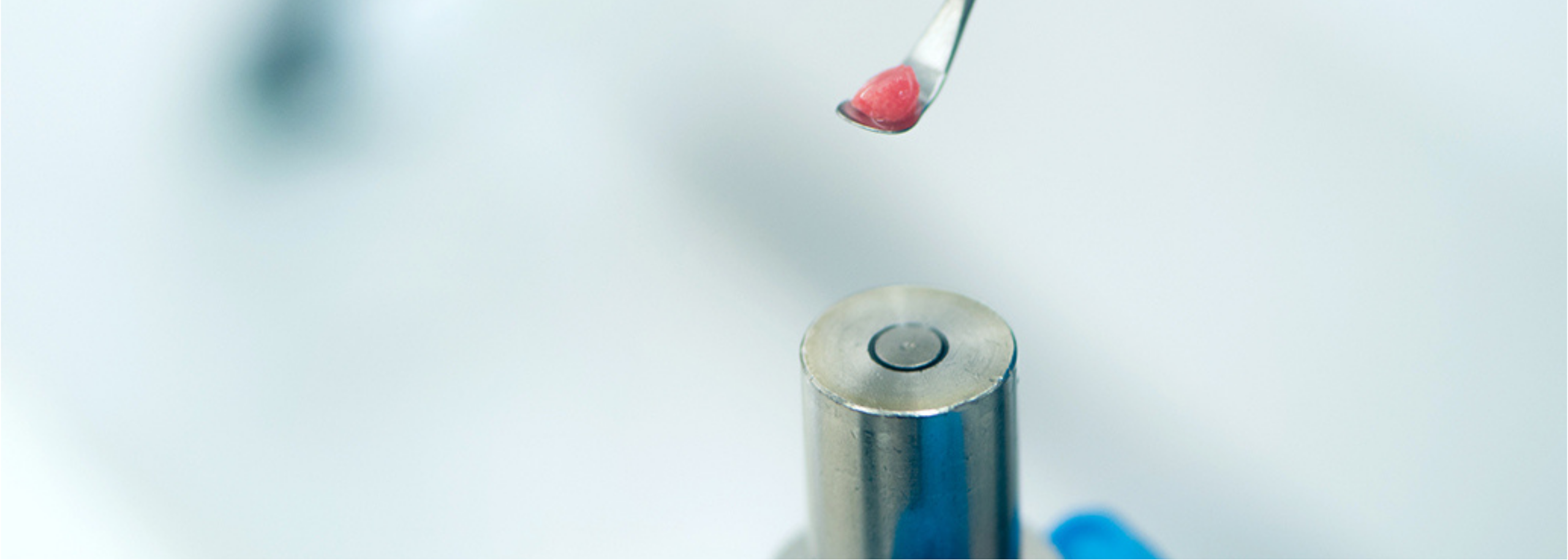
Brain stem tumours look like small white balls. Nils: ‘To the naked eye, I think they look a bit like Tic-Tacs. But under a microscope, you can see layered, brain-like structures and you can even see tumour cells invading healthy tissue – just like what happens in young patients.’
Continuing to develop
In the coming period, Anne Rios’ group wants to improve the cultivation of brain stem tumours in a dish, so that they can make their research with mini brain stems even more reliable.
Because no matter how important adding blood vessels is, the work is not done yet.
‘As a scientist, you constantly swing between two states of mind,’ explains Nils. ‘One day I am extremely happy with a result we have worked hard for, but the next day something new is already gnawing at me and I focus on the next step.’
Big ambitions
Nils has big plans for after his time at the Princess Máxima Centre. He would like to incorporate the model into Nydus R&D, the company he has set up. ‘That way, we can offer brain stem tumours in a dish to other parties and thus accelerate the search for new treatments for children with DMG,’ he explains.
At Nydus R&D, he wants to do this in a way that is explicitly free of animal testing. ‘We have learned a lot from research with mice, but we have reached the ceiling. In order to really help patients with new treatments, we need to switch to animal-free models.’
His ambition is to further automate the process of growing brain organoids. And regarding the impact, he says: ‘Each specimen can replace one laboratory mouse. We could already replace 80 mice per month in a laboratory. If more laboratories start using this model, you quickly end up with thousands per year.’
Just the right moment
According to Nils, now is the time to take action. ‘Timing is crucial in scientific research too. Sometimes innovations fit perfectly into the broader picture of what is happening in the world at that moment. I see that happening in our field right now. Several new scientific discoveries have recently been made using mini-tumours grown in the laboratory. In addition, both regulatory authorities and commercial parties are increasingly recognising the importance of alternatives to animal testing.’
Better treatments, fewer laboratory mice
With valuable research such as that conducted by the Dream3D lab team and ambitious young researchers such as Nils, we are bringing animal-free research ever closer.
What does Nils hope to achieve by persevering? That in ten years’ time, we will be able to say that the work we are doing now has led to better treatments and fewer laboratory mice. And that it has inspired other young researchers to break with old standards as well.
Would you like to support Nils and his colleagues in their research? Please assist us in taking the next step towards animal-free research!
Discover more