
How it can be done
“We cannot do research without monkeys yet.” That is often said when discussing the future of medical research. Yet, researchers are already working with models based directly on human biology.
Following the extension of funding for primate experiments beyond 2030 (as announced in the letter from Minister of Education, Culture and Science Rianne Letschert on July 3, 2026), we delved into the current state of animal-free science.
Because we are certain that things can be done differently—and so is a whole generation of researchers who want to see more results from medical applications that work in humans rather than (maybe) in animals.
That is why we asked them: how can we conduct research that is animal-free *and* achieves the best results for humans? What is already possible if we take human-centered models seriously?
This is part 2 of a series. Read part 1, an interview with researcher Bas van Balkom, here.
Nils Bessler, researcher
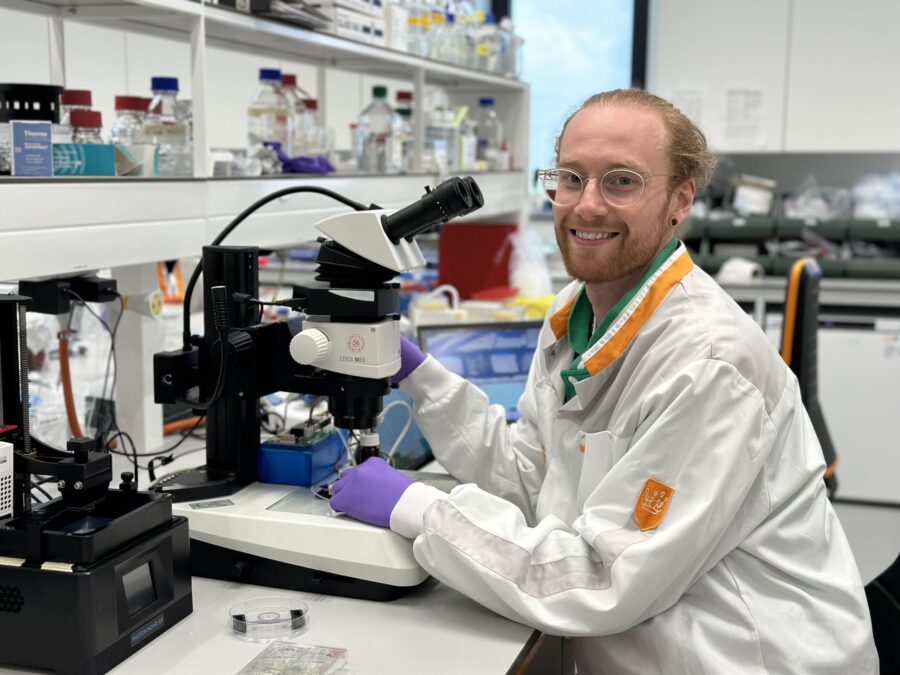
Postdoctoral researcher Nils Bessler conducts animal-free cancer research by mimicking the complex environment of the human brainstem in the laboratory. He is investigating a rare form of cancer that is very aggressive, difficult to cure, and mostly occurs in the brains of children.
Looking at the disease as a whole
“I’ve been working on a new, human-based model, called brainstem organoids, or in short: ‘the bros’ (BrO’s*). The idea is that we are growing healthy brainstem tissue for a disease called diffuse midline glioma, which is a cancer that manifests almost exclusively in the brainstem. We try to develop new models in order to have more options. What is quite dominant in the field is to use mice, next to cell lines or patient-derived material. That is often not sufficient when you want to work on therapies and want to investigate this disease in the actual complex environment of what we see in the patient. The patient has blood vessels, and immune cells, which are surrounding the tumor tissue. You also have neurons, or astrocytes, which are part of the nervous system. And they are interacting with the cancer. It’s not like cancer is an isolated situation.”
* BrO: abbreviation from the “Brainstem-regionalized Organoids” or “Brainstem Organoids”
Predicting the human response
“The reality is complex. A lot of therapies might work in the dish or in a mouse, but it won’t work in the patient. That was my motivation to come up with a new model, the brainstem organoids. The idea was to create a complex model by setting up this brainstem environment, including immune cells in this context, and blood vessels, and including this in complex models like organoid-on-a-chip models. The idea is to have this tissue growing inside of this complex environment and to be able to predict an outcome and recreate an environment, what we then see in the patient. The central idea is to create this complexity and then from there hope that the cancer itself that we’re creating, but also the context of the environment, is sufficient enough to get a better prediction.”
How does this animal-free approach already benefit us?
“I believe it’s a conceptually new and good way of looking at the cancer. So I do believe that we have opened up new possibilities of recreating this cancerous heterogeneity, which is an absolutely important point. And you are always having a human background when you’re introducing those immune systems. So this is a huge advantage compared to animal models. There are fundamental changes between the mouse immune system and the human immune system.”
“There are fundamental changes between the mouse immune system and the human immune system.”
What is the essence of human centered research?
“By just combining a human immune cell in a human system with a human cancer, we can guarantee that what we’re investigating and what we’re seeing, at least to some degree, can really be closer to the human situation. I think our work enables us to get a very detailed view about human specific interactions that you wouldn’t be able to see when we would just use mouse models or a combination of mouse and human models. These interactions – and especially in the brain – the human brain is so specific. It’s one of the most species specific thing as much as our immune system is very species specific. And it’s literally about those interactions between the healthy nervous system, the healthy immune system and the cancerous tissue that is guided by human principles.”
“Ultimately, I believe there is a benefit for the patient.”
How do we go forward in using animal-free models?
“When more people will use organoid models, more evidence and more reliability and more standardized ways of this insight and knowledge will be available, which will ultimately – in the perfect scientific world – be convincing to everyone in this community. The demand will be there, and then reviewers of research proposals and funding will say: you should also research this in more complex in vitro models*. This is ultimately what I want to see, that the scientific evidence will speak for itself. And then the evidence will be there and people will be able to demand it and say: ‘it’s great that you found this, but let’s put it in a much more complex environment and then we’ll see if it holds true’. I developed this model in order for people to adapt and to see what it brings. Because ultimately, I believe there is a benefit for the patient.”
*In vitro and in vivo are two important terms in science for understanding biological processes and developing new treatments:
- In vitro refers to experiments that take place in a controlled environment outside a living organism, often in a laboratory or test tube. This type of research is often used for growing cells or testing medicines in a culture site.
- In vivo means that the research takes place within a living organism, such as testing medicines in laboratory animals or clinical trials with humans. This type of research is used as a natural context for studying biological processes.
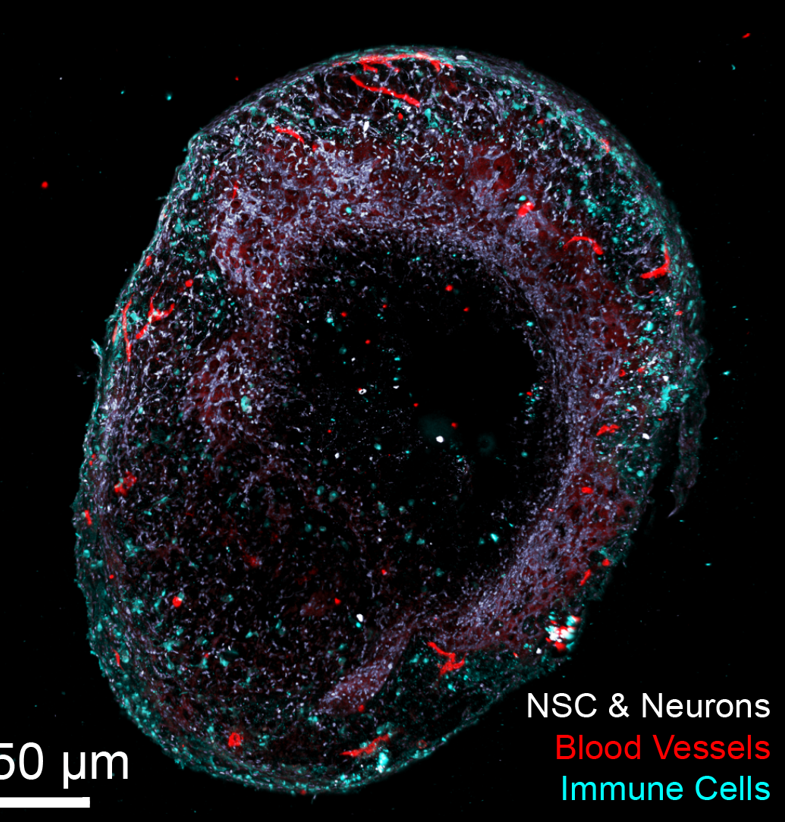
This picture is from the brainstem research by Nils and his team and shows a.o. neurons and blood vessels. ePhoto credits: Nils Bessler, Anne Rios en Rijndert Ariese (DREAM3DLAB).
About Proefdiervrij
How we treat animals says something about who we are as a society. Especially when those animals are used in research intended to make people better. Proefdiervrij is working towards a world without animal testing by making human-centered, animal-free science visible and accelerating it.
That change is already underway. Increasingly, animal testing is being replaced by human-centered models that better show what happens inside the human body. Yet, animal testing often remains the standard. With 2030 as the target, we are working towards a tipping point where animal-free methods are the norm. In this way, we help let go of what no longer fits and build research that helps people, without using animals unnecessarily.
It is time for humanity. The future is animal-free!
Discover more