
Endometriosis is a condition in which tissue similar to the lining of the uterus grows outside the uterus. This can cause severe pain, affect fertility, and significantly limit daily life. Yet, there is still much we do not know about the disease. While high-quality research is urgently needed, animal models are particularly inadequate for studying endometriosis. For this reason, Roman Truckenmüller and his team at FEMChip are developing human-based research models designed to provide a better understanding of the disease.
A disease that long remained hidden
Roman Truckenmüller is a professor of microtissue engineering at Maastricht University and the project leader of FEMChip. During the project’s preparation, he was particularly struck by the stories shared by the women themselves. “It’s about pain and infertility,” Roman explains. “But the consequences go much further. Sometimes, their symptoms even prevent these women from being able to work.”
His colleague, Paul Wieringa, initially became involved out of scientific interest. He conducts research into the peripheral nervous system and was already working on a model to study the interaction between nerves and endometriosis tissue. It is estimated that approximately one in ten women has endometriosis—possibly even more. Throughout the project, Paul realized just how close to home this disease actually is. “The more I started talking about it, the more I discovered how many people around me have endometriosis themselves.”
Interactions with physicians made the urgency even clearer. “You realize how frustrating it is for them that they cannot do more for their patients.”
Why a mouse is not a woman
Researching endometriosis presents a unique challenge: most mammals do not menstruate, nor do they naturally develop endometriosis. “In some primates, endometriosis can occur spontaneously,” Paul explains. “But in mice, the disease has to be artificially induced.”
This is done, for example, by placing uterine tissue into the abdominal cavity. But how accurately does such an animal model reflect what happens in a woman’s body? “If a mouse’s body functions differently from a woman’s in such critical ways, you are faced with a limitation from the very start,” says Paul.
Conducting research involving women is also complex. In the case of young women, you wouldn’t want to perform procedures that could potentially affect their fertility, solely for the purpose of collecting research material. Consequently, the tissue that does become available often comes from women undergoing surgery due to severe symptoms. “In those cases, you’re looking at the extreme end of the spectrum,” says Paul. “Yet, what you really want is to understand what happens earlier on in the disease, so that you can diagnose or treat it sooner.”
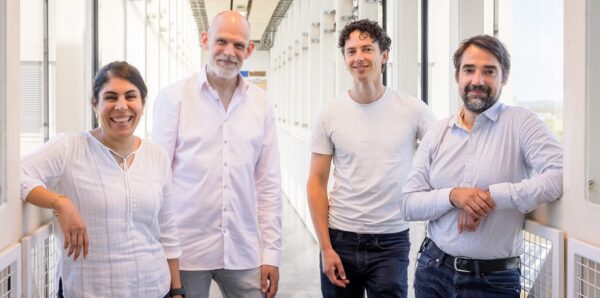
The FEMChip- research team (from left to right): Nilofaar, Roman, Erik en Paul
Then you build something else
And that is where FEMChip comes in. The researchers build human models in which cells and tissue from patients can be studied in the laboratory. “In a sense, we are all builders,” Paul chuckles. “We can create many different things. But the big question is: is what we’re building actually relevant?”
Different models address different research questions. For instance, Paul investigates how nerves respond to endometriosis tissue. Other team members focus on the uterine lining, fertility, and embryo implantation. These models can subsequently be expanded to include components such as blood vessels, immune cells, or other cell types.
However, building something is not enough on its own. The researchers compare their models against patient material and other real-world data. “We don’t always have sufficient evidence yet that a given model is truly representative of the tissue we are attempting to replicate,” says Paul. “You first need validated tools. Only then can you offer them as an alternative.”
He sums it up vividly: “If something looks like a duck and quacks like a duck, it’s probably a duck. Though, in this case, it’s a very specific kind of duck.”
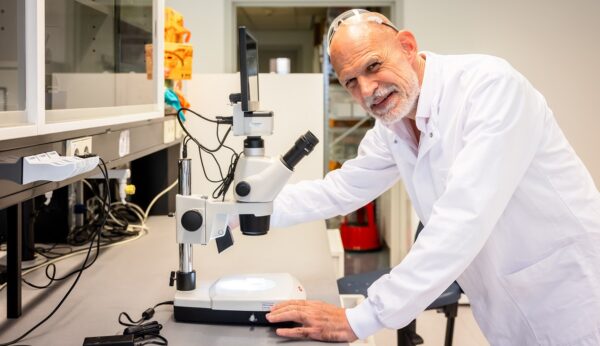
Leader of the research team, Roman Truckenmüller, in the lab
Animal-free—even within the chip
Not using laboratory animals does not automatically mean that research is entirely free of animal-derived material. In the laboratory, human cells require nourishment and structural support—needs traditionally met using substances sourced from animals. “We want to replace those components, too,” explains Roman. “So, it’s not just about replacing the animal model with a chip; we also want to eliminate the animal-derived products used within that system.”
This requires careful investigation, as replacing animal-based components can affect how human cells grow and function. “If you have a completely animal-free model that no longer functions properly, it’s of no use,” says Roman. “That is why we are exploring how to replace these components without compromising the reliability and relevance of our models.”
For Roman, this is part of a researcher’s responsibility: rather than simply continuing to rely on existing animal models and animal-derived materials, one must constantly re-evaluate whether a viable alternative has become available.
Moving forward, step by step
FEMChip is already demonstrating that research into endometriosis and fertility can be conducted largely without the use of laboratory animals or animal-derived materials. By further developing and validating human-based research models, the researchers aim to continue reducing the use of laboratory animals.
Support from Proefdiervrij helps the team further develop human-based models and animal-free cell culture methods. Roman says: “We are incredibly grateful to the donors. Projects like this cannot simply be taken for granted; their support makes it possible for us to actually develop these alternatives.”
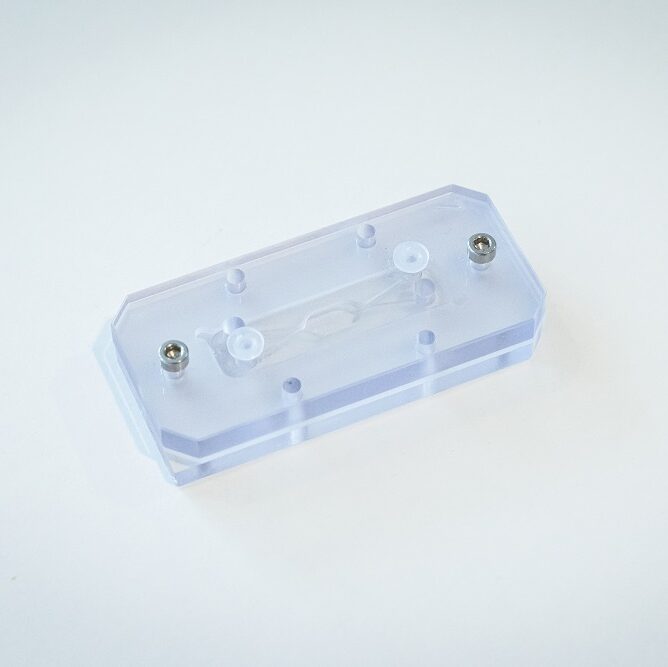
In this way, FEMChip brings two goals closer: research that is better aligned with the bodies of women with endometriosis, and research that is increasingly less dependent on animals.
FEMChip is teamwork
FEMChip is a collaborative project that brings together researchers with diverse areas of expertise. In Maastricht, project leader Roman Truckenmüller, along with Paul Wieringa, Erik Vrij, and Niloofar Tahmasebi Birgani, are working on various components of the research. Paul is investigating, among other things, the interaction between endometriosis tissue and nerves; Erik focuses on fertility and embryo implantation; and Niloofar works on developing models and materials that support the growth of human cells.
Beyond Maastricht, several other partners are also collaborating within the FEMChip project. Teams in Maastricht and Utrecht are developing in vitro models and have access to patient-derived material through their affiliated hospitals. Amsterdam UMC contributes expertise in imaging techniques, such as ultrasound and micro-CT. Researchers from Radboud assist with analyses that allow the laboratory models to be compared against actual patient tissue and the behavior of cells within that tissue.
By combining these various areas of expertise, FEMChip is able not only to develop these models but also to validate them against the reality of the human body.
About Proefdiervrij
How we treat animals says something about who we are as a society. Especially when those animals are used in research intended to make people better. Proefdiervrij is working towards a world without animal testing by making human-centered, animal-free science visible and accelerating it.
That change is already underway. Increasingly, animal testing is being replaced by human-centered models that better show what happens inside the human body. Yet, animal testing often remains the standard. With 2030 as the target, we are working towards a tipping point where animal-free methods are the norm. In this way, we help let go of what no longer fits and build research that helps people, without using animals unnecessarily.
It is time for humanity. The future is animal-free!
Discover more