
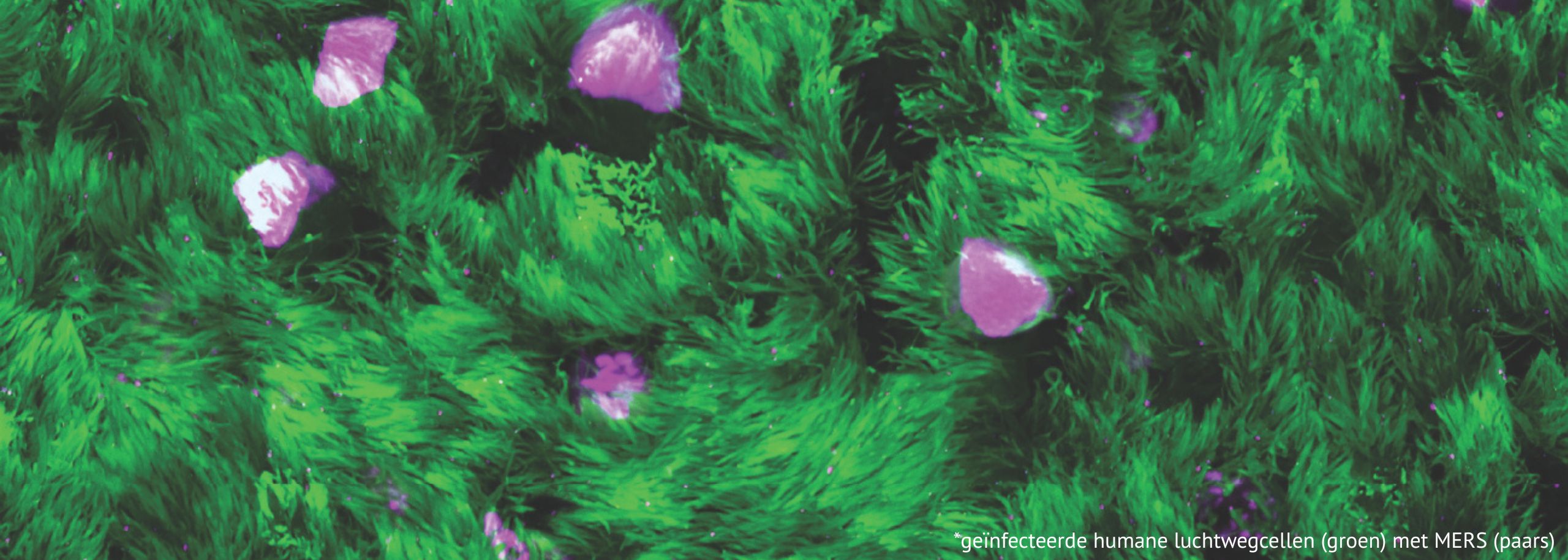
In the photo above we see: infected human airway cells (green) with MERS (purple).
In brief:
- Research using organoids (mini-organs grown from stem cells) shows how viruses really behave in human cells
- This method yields more relevant insights than traditional cell line models
- It shows that innovative, human-centered research is already possible and is increasingly becoming the standard
Tim Breugem, a researcher at Erasmus MC, conducted research into coronaviruses for his dissertation and demonstrates that major scientific strides can be made without animal testing. In his work, he uses organoids (mini-organs grown from human or animal stem cells) to study viruses such as SARS-CoV-2 and MERS-CoV. “Using organoids sometimes feels like science fiction,” says Breugem enthusiastically, “but it is simply reality.”
“Traditionally, viruses were studied using cell lines or in laboratory animals,” explains Tim. Cell lines consist of a group of unnatural cells often derived from tumors or genetically modified cells, and barely reflect the real situation in the human body. It is also questionable whether results from animals can be reliably translated to humans. Both situations are a bit like comparing pears and apples, but with organoids, we are fortunately finally comparing apples and apples.
Research into coronaviruses
But what exactly did Tim and his team investigate with organoids? “We looked at airway organoids to investigate how viruses infect human cells. To do this, we manipulate stem cells so that they develop into airway cells, almost identical to those in the human body. This allows us to determine much more precisely how a virus behaves.”
We funded the printing costs of Tim’s dissertation. Are you also a scientist conducting animal-free research who could use some help? Then read all about our collaboration opportunities here!
For example, Tim discovered that the MERS virus (a coronavirus found in dromedaries in the Middle East), contrary to what was previously thought, can indeed multiply in the upper respiratory tract cells of some people. That insight would not have been possible with classical animal testing, but it was with organoids based on human stem cells. Tim: “Organoids are a huge step forward in reducing animal testing and improving the relevance of our research.”
Benefits of organoids
Organoids offer benefits not only for research into human infections but also for testing viruses in animals. For example, together with his colleagues, Tim used a piece of tissue from an alpaca—the small cousin of the dromedary in which MERS naturally occurs—to cultivate organoids and thus investigate whether and how the virus spreads without having to use live animals. For animal-oriented research—and thus also for cultivating animal organoids—animal material is naturally required. Fortunately, this material is often available through a biobank, so no animals need to be killed for it.
Tim received this piece of tissue from his Spanish colleagues in Barcelona. “This way, we can conduct endless research with a single sample.* Moreover, organoids offer the possibility to conduct research on animals that are difficult to work with or are protected, such as bats, provided a piece of tissue is available.”

Tim Breugem
However, Tim is also honest about the current limitations of organoids. “Organoids are incredibly valuable, but they do not replace everything yet. We cannot replicate a complete immune system, and you cannot vaccinate with an organoid,” he explains. “That makes it difficult to test the effectiveness of a vaccine without animal testing.”
From niche to standard
The fact that this is not yet possible naturally does not mean that it will never become possible. For instance, Tim has seen the field change rapidly over the past five years. “Organoids started as a niche, but are now almost the standard in virology,” he says proudly. His team was ahead for years, but is now being caught up by colleagues worldwide. And he wholeheartedly welcomes that. “The more labs gain access to these models, the better for science.”
According to Tim, switching to organoids is primarily a matter of time, money, and a change in mindset. “Some labs are so accustomed to animal testing that they automatically resort to it.”
So, it is time to encourage good human-centered research methods. For instance, Tim’s research with airway organoids shows that this method can lead to valuable insights within virology without the need for animal testing.
Animal-free future
Not a scientist, but still want to contribute to animal-free research? Read this to find out how you can help. Are you a scientist? Then read more about how we can work together!
About Proefdiervrij
The way we treat animals says something about who we are as a society. Especially when those animals are used in research intended to improve people’s health. Proefdiervrij is working towards a world without animal testing by raising the profile of and accelerating human-centred, animal-free science.
That change is already underway. Increasingly, animal testing is being replaced by human-centred models that better reflect what happens in the human body. Yet animal testing often remains the norm. With 2030 on the horizon, we are working towards a tipping point where animal-free methods are the norm. In this way, we are helping to move away from what is no longer appropriate and building research that helps people, without using animals unnecessarily.